





























Senate Won’t Be Intimidated, Akpabio Tackles Critics Over Electoral Act
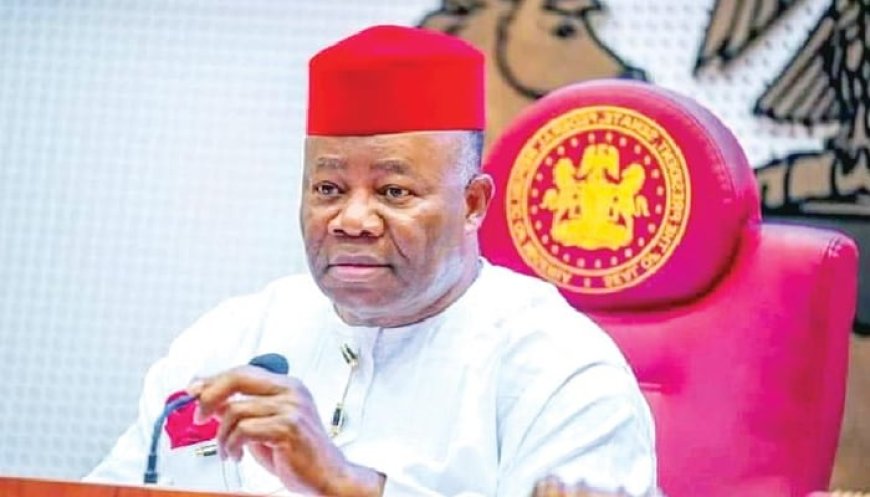
Adedayo Akinwale and Sunday Aborisade in Abuja
The President of the Senate, Senator Godswill Akpabio, yesterday fired back at opposition political parties, civil society organisations, and other non-governmental organisations over the barrage of criticisms trailing the Senate’s rejection of compulsory electronic transmission of election results in the Electoral Act Amendment Bill.
The Senate president vowed that the Red Chamber would not be cowed or intimidated into passing what he described as a faulty law, adding that lawmaking is a grave constitutional responsibility that goes far beyond public sentiment, television debates, or pressure from interest groups.
Akpabio spoke in Abuja at the public presentation of a book, “The Burden of Legislators in Nigeria,” authored by former Senator Effiong Bob, where he used the occasion to mount a spirited defence of the Senate’s decision to remove the phrase ‘real-time’ from provisions relating to electronic transmission of election results.
Akpabio declared that lawmaking is a grave constitutional responsibility that goes far beyond public sentiment, television debates, or pressure from interest groups.
“The burden of lawmaking is where every clause must balance liberty with order. The burden of representation is that millions of voices must be expressed through a single vote.
“The burden of oversight is where power must be questioned without malice, and the burden of budgetary control is where national dreams must be matched with fiscal discipline,” Akpabio said.
He stressed that these responsibilities were often carried out under intense public scrutiny and frequent misrepresentation, noting that while democracy thrived on openness and transparency, criticism should not degenerate into abuse.
The Senate president said: “Democracy breathes through social interrogation, but citizens are not free to abuse the legislature,” lamenting what he described as premature judgments on a bill that, procedurally, had not been concluded.
Akpabio explained that the Electoral Act amendment process was still incomplete, as the Votes and Proceedings of the Senate had not yet been adopted, insisting that it was only after that stage that the final position of the Senate could be fairly assessed.
“Until we approve the votes and proceedings, the bill is not completed. Any Senator can still rise to say that the record does not reflect the agreed outcome, and it can be corrected. Why are people setting up panels on television stations and abusing the Senate when the process is incomplete?” he queried.
Reacting directly to the outrage over the removal of “real-time” transmission of results, Akpabio clarified that the Senate did not abolish electronic transmission, but merely declined to make it mandatory under all circumstances.
“All we said was that the word ‘real-time’ should be removed. If you want to transmit results electronically, do so. If you want to use your phone, iPad, or any device, do so. But if you make real-time transmission mandatory and there is a network failure or a grid collapse, what happens to the election?” he asked.
He warned that insisting on real-time transmission without regard to Nigeria’s infrastructural realities could throw the country into chaos, particularly in areas grappling with insecurity, poor electricity supply, and weak telecommunications networks.
“In states where networks are not working, does it mean there will be no election? If the national grid collapses, will no results be valid nationwide? Technology must serve democracy; it must not endanger democracy,” the Senate president said.
Drawing from international experience, Akpabio referenced the disputed 2000 United States presidential election between George Bush and Al Gore to illustrate that even advanced democracies still grapple with challenges associated with electronic voting systems.
He accused some NGOs and civil society actors of attempting to impose positions reached during retreats on lawmakers, stressing that consultations should not replace deliberations on the Senate floor.
“Retreats are part of consultation; they are not lawmaking. Why do you think that what was agreed in a retreat must automatically be passed on the floor? That is not how democracy works,” he said.
Akpabio maintained that the Senate would not make laws to favour individuals, opposition parties, or those currently in power, but for posterity and generations unborn.
“We will not be intimidated. We will do what is right for Nigeria. Laws must outlast us,” he added.
Source: THISDAY