



























Sadiku: Report Exposes Terrorist Leader Behind Brutal Kwara Massacre
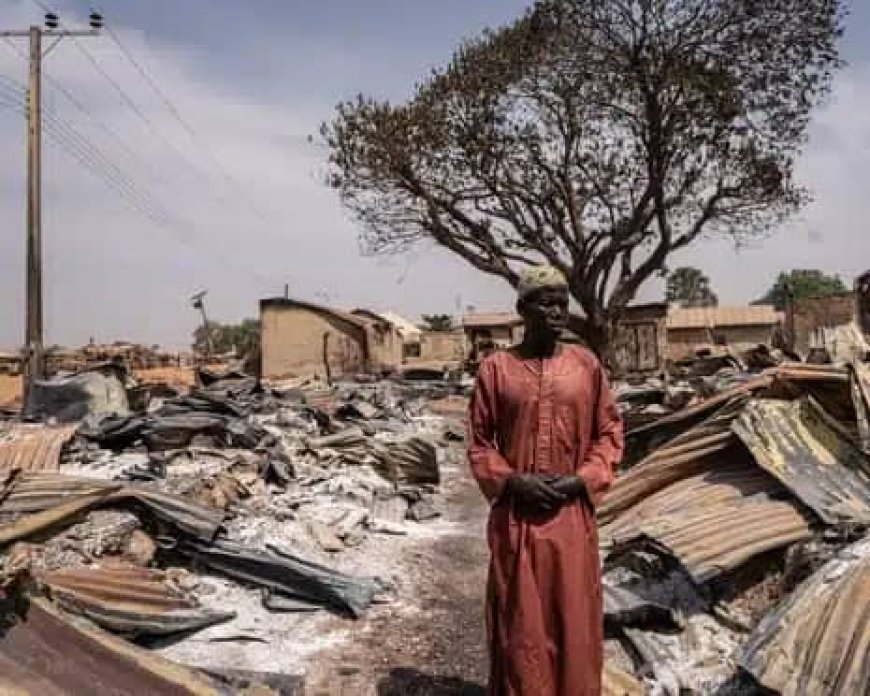
Tuesday’s massacre in Woro, a remote community in Kaiama Local Government Area of Kwara State, which left an estimated 176 residents dead, was not a random act of violence.
Investigations by Saturday PUNCH indicate that the attack was the culmination of what analysts describe as a calculated expansion of a jihadist front into Nigeria’s North-Central region, an advance that reportedly occurred despite prior warnings.
At the centre of the bloodshed is a terrorist commander identified as Abubakar Saidu, popularly known as Sadiku, whose violent footprint now stretches across multiple regions of the country.
From Shekau’s Lieutenant to North-Central Kingpin
Security sources trace Sadiku’s rise to 2014, when he was reportedly selected by the late Abubakar Shekau, then leader of Boko Haram, to expand the insurgent network beyond its North-East strongholds.
Over the years, sustained military pressure weakened Boko Haram’s bases in Borno and surrounding states, forcing splinter factions westward. Investigations suggest Sadiku embedded himself in forest corridors spanning Niger and Kwara states, steadily consolidating influence.
By 2026, some analysts now describe him as the “Shekau of the North-Central,” citing his operational independence and ideological rigidity.
A self-styled counterterrorism analyst on X, MobilisingNigeria, claimed Sadiku initially collaborated with notorious bandit leader Dogo Gide to expand influence into the North-Central terrain and later engaged with the Darul Islam faction before it was dismantled by police operations.
However, ideological disputes reportedly fractured these alliances, pushing Sadiku deeper into forest strongholds.
Kainji Forest: Nigeria’s ‘New Sambisa’
In July 2025, Sadiku is believed to have established a strategic base inside the Kainji Forest Reserve, a vast territory stretching across Niger and Kwara states.
Security experts describe Kainji as Nigeria’s “new Sambisa,” referencing the Sambisa Forest that long served as Boko Haram’s operational base in the North-East.
A Kwara-based security analyst, Hassan (surname withheld), told Saturday PUNCH that the relocation signalled a dangerous insurgent expansion westward.
“For over a decade, Boko Haram violence was concentrated in Borno, Yobe and Adamawa. Now splinter factions are exploiting forests, porous borders and weak security presence to push westward,” he said.
The reserve now allegedly functions as a logistical corridor linking insurgents in the North-East with armed groups in the North-West.
Possible JNIM Links
West and East Africa sechurity tracker Brandon Phillips linked Sadiku’s faction to the Woro massacre, noting that the attack occurred less than four kilometres from Nuku, where Jama’at Nusrat al-Islam wal-Muslimin (JNIM), an Al-Qaeda affiliate in the Sahel, claimed its first attack in Nigeria in October 2025.
Phillips suggested the proximity indicates possible operational overlap between JNIM and Sadiku’s Boko Haram faction — either through cooperation or a non-aggression understanding.
He further noted similarities between the Woro killings and recent attacks in Papiri, Niger State, indicating a continued southward push toward Kainji-dominated territory.
Another researcher, Raheem Mutiu, said JNIM fighters were spreading across Kaiama, Baruten and Borgu areas, consolidating influence after the arrest of a local factional leader in August 2025.
African conflict analyst James Barnett observed that the brutality of the Woro massacre marked a shift from previous factions that had largely limited violence to retaliation against military operations.
The Warning Letter
Findings reveal that Woro community had received prior warning.
The village head, Salihu Umar, confirmed that a letter written in Hausa and dated 19 Rajab 1447 (January 8) was delivered to him about three weeks before the massacre.
The letter, signed by “JAS” (an acronym associated with Jama’atu Ahlis Sunna Lidda’adati wal-Jihad), stated that the group intended to “secretly” meet community leaders to preach and would not harm residents.
Umar said he photocopied the letter and submitted it to the Kaiama Emirate and forwarded a soft copy to the Department of State Services office in Kaiama.
The Execution
Eyewitnesses said the attackers arrived around 5pm on motorcycles, armed with AK-47 rifles and explosives.
They reportedly blocked exit routes and stormed the Emir’s palace at about 6pm, dragging out family members and setting the building ablaze.
Between 6.30pm and 8 pm, survivors described what they called an “execution phase,” during which men were rounded up, hands bound, and killed.
A military aircraft reportedly appeared around 8 pm, forcing the attackers into nearby bushes. Some residents emerged from hiding around 9 pm, believing the threat had passed.
However, the assailants regrouped and allegedly used the call to prayer as a ruse to lure residents out before resuming killings.
The violence subsided around 2 am as the attackers retreated into the forest with abducted women and children.
Source: Punch