



























Re-Work of Fiction: Linus Obogo's "The Ghost of a Vanquished Ambition"

By Emmanuel Edok
It is remarkable how quickly people forget both historical milestones and personal experiences. This tendency is aptly illustrated in a recent article by Linus Obogo, Chief Press Secretary and Special Adviser on Media and Publicity to the Governor of Cross River State. In his commentary, The Ghost of a Vanquished Ambition, Mr. Obogo offers a critical assessment of Prof. Sandy Onor, a political figure whose career has been shaped by both electoral victories and defeats.
Mr. Obogo appears to suggest that Prof. Sandy Onor is driven by bitterness following his defeat in the 2023 governorship election. This assertion raises important questions. What actions or statements justify such a conclusion? Has Mr. Obogo forgotten the occasions when his own principal experienced political setbacks? It is equally noteworthy that he omits the fact that his principal also served only one term in the Senate, despite repeatedly referring to Prof. Sandy Onor as a "one term senator." Such selective recollection reflects the inconsistency that often characterizes partisan political discourse.
Politics is indeed a great leveler. That reality explains why individuals elevated by circumstance sometimes speak without reflection and write without appreciating uncomfortable truths expressed in the public interest. It is against this background that Prof. Sandy Onor's assertion that Cross River State is being governed by "mediocres" should be examined on its merits rather than dismissed through personal attacks.
Never in the history of Cross River State has governance been reduced to such a spectacle. Several commissioners appear to hold titles without exercising the full responsibilities of their offices, as many of their official functions have been glaringly assumed by others within Otu's inner cartel. It is unprecedented that the Commissioner for Information and the Chief Press Secretary, who should ordinarily shape and coordinate government communication, are increasingly limited to issuing Executive Council resolutions, appointment notices, and rejoinders, while individuals with little or no background in public communication or administration publicly speak for government, inspect projects, and perform functions traditionally reserved for designated officials. Similar concerns have been expressed in other ministries, including Aviation and Women Affairs. This has fueled public perception that governance in the state is becoming increasingly disjointed and poorly coordinated.
Mr. Obogo's principal is also confronted with significant governance challenges as the incumbent governor. Consequently, many citizens have begun to question whether the electorate made the right choice during the last governorship election. For some, this reflection recalls the biblical account in which the crowd chose Barabbas instead of Jesus. Whether that comparison is appropriate is left to individual judgment, but it underscores the growing public debate over the state's direction.
The article also conveys the impression that Mr. Obogo is more concerned with pleasing his political benefactor than confronting uncomfortable realities. Reports that he has, at different times, been publicly and privately sidelined within the administration only reinforce questions about the sincerity of his intervention.
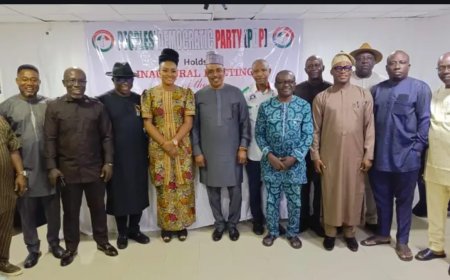
Meanwhile, Prof. Sandy Onor's political relevance remains evident. His emergence as the Peoples Democratic Party's presidential candidate and his successful assertion of authority at the party's Wadata national headquarters demonstrate enduring influence. Senator Mbadiwe's description of Prof. Onor's transformation from "a caterpillar in politics to a juggernaut" captures the remarkable evolution of his political career.
This is not an attempt to defend Prof. Sandy Onor's description of the current administration as one run by "mediocres." Rather, the administration should be assessed on measurable indicators of governance after three years in office. The public must objectively determine whether Prof. Onor's criticism reflects reasoned concern over the state's trajectory or merely personal disappointment. That judgment ultimately belongs to the people of Cross River State.
Mr. Obogo also asks who best represents mediocrity between Governor Bassey Otu and Prof. Sandy Onor. Such a comparison requires clearly defined standards. Their records in public office, legislative performance during their respective Senate tenures, educational attainments, administrative competence, and personal integrity should all form part of any objective evaluation. Without such benchmarks, sweeping accusations amount to little more than political rhetoric.
When political sentiments are set aside, many observers believe Cross River State has experienced significant governance challenges under the present administration. A growing sense of public dissatisfaction is evident, as many citizens feel that governance has become concentrated in the hands of a small circle whose stewardship has failed to inspire widespread confidence. Whether this perception is justified will ultimately be determined by the electorate.
Politics is dynamic, and no office is permanent. Today's leaders may eventually give way to tomorrow's. It is therefore imperative that public officials embrace accountability, transparency, and purposeful leadership. As Cross River State approaches another electoral cycle, the people will once again decide the future they desire. May wisdom, justice, and the fear of God guide that choice.
It is rather ironic that a Chief Press Secretary who has been sidelined, not on the basis of competence or merit, but because of primordial considerations, would choose to sacrifice his conscience by attacking a man widely regarded for his intellectual depth and administrative competence. These are qualities that many would argue are absent in the administration he now vigorously defends, seemingly at the expense of objective and patriotic criticism aimed at exposing the alleged financial irregularities and governance shortcomings within the Otu administration.
Rather than engaging in personal attacks or acts which tantamount to the last kicks from a malnourished dying horse, Linus Obogo should focus on confronting the internal forces that have usurped his responsibilities, reducing him to a ceremonial spokesperson whose primary assignment appears to be issuing rejoinders. Such circumstances deserve his attention more than attempts to discredit perceived political opponents.
The road to 2027 will be challenging and unpredictable. Beyond political affiliations and ethnic sentiments, the electorate will ultimately determine the state's future. Cross River State cannot afford to continue drifting without a clear vision and purposeful leadership. Allegations of financial impropriety, reckless spending, and the accumulation of wealth through questionable means, especially while many pensioners and ordinary citizens continue to endure hardship, deserve transparent and convincing responses rather than outright dismissal or deafening silence, which presupposes, guilt and admmiittenc to the crime
The Holy Bible admonishes us to remove the plank from our own eyes before attempting to remove the speck from another person's eye. In the same spirit, Linus Obogo should prepare to address the issues before him with verifiable facts, credible evidence, and logical arguments. The growing allegations circulating across social media demand empirical proof and transparent explanations, not rhetorical flourishes or grammatical displays that fail to address the substantive concerns raised by Distinguished Senator Sandy Onor.
Comrade Emmanuel Edok is a Cross Riverians based in Canada