























"Parliamentary Appointments Not Proof of Support For Cross River," Group Tells Akpabio

By Missang AKPET
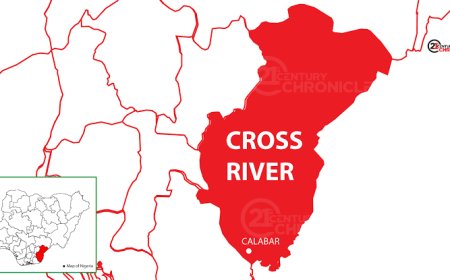
The Cross River State Consultative Forum (CRSCF) has said political courtesy and parliamentary appointments involving Cross River officials should not be interpreted as evidence that the state’s outstanding maritime and oil-resource disputes have been resolved.
The Forum made the position in a statement responding to remarks attributed to Senate President Godswill Akpabio at the 39th anniversary of Akwa Ibom State.
According to the CRSCF, the attendance of Cross River politicians at events involving the Senate president, as well as the appointment of Cross River senators to leadership position in the National Assembly, were matters of parliamentary and political cooperation.
It said such relationships were welcome but did not determine the substantive questions surrounding Cross River’s maritime status, offshore oil wells and derivation revenue.
“Attendance at an event with a Cross River senator, or the appointment of another as Chairman of the Senate Committee on the NDDC, are acts of parliamentary and political collegiality,” the Forum said.
“They are welcome. They do not, however, convert contested geographic, legal, and revenue issues into settled goodwill.”
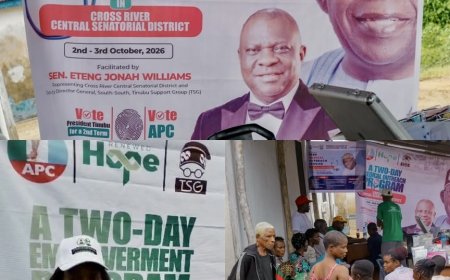
Senator Asuquo Ekpenyong represents Cross River South Senatorial District and chairs the Senate Committee on the Niger Delta Development Commission. Eteng Williams of Cross River Central chairs the Senate Committee on Petroleum Upstream. While Jarigbe Agom Jarigbe of Cross River North chairs the Senate Committee on Gas.
The CRSCF said the state’s claims concerning maritime status and offshore resources were institutional matters that should be addressed through law, technical evidence and the appropriate federal agencies rather than through political relationships.
The Forum’s position comes amid continuing disagreement over Cross River’s status following the 2002 judgment of the International Court of Justice on the Nigeria-Cameroon boundary and the subsequent transfer of Bakassi Peninsula to Cameroon.
The Supreme Court, in a 2012 judgment involving Cross River, the Federal Government and Akwa Ibom, held that Cross River had lost its littoral status following the implementation of the ICJ judgment. The decision had implications for the state’s claim to derivation revenue from offshore oil wells.
Cross River has, however, continued to pursue claims concerning offshore oil resources and has argued that technical verification should determine the location and attribution of the disputed wells.
The CRSCF said the issue remained unresolved and should not be conflated with political relationships between individuals from the two states.
The Forum cited different figures from government and inter-agency exercises concerning oil wells associated with Cross River, including 76 wells identified by a 2004 presidential committee, 67 reportedly identified in a 2024 inter-agency exercise and 119 cited in a 2025 inter-agency report.
It called for the relevant government agencies to establish the definitive position through scientific, geographical, geological and maritime evidence.
The Forum also disputed the description of Cross River as landlocked, arguing that the state retains an estuarine connection with the Atlantic Ocean through the Cross River and Calabar waterways.
It said the 2012 Supreme Court decision should be understood within the specific legal context of derivation and offshore oil-well attribution and should not be interpreted as having altered the physical geography of the state.
The organisation further challenged a reported claim that 40 per cent of Cross River’s population were “Akwa Ibom people”, saying it was not aware of any official census or credible demographic study supporting the figure.
It argued that historical migration, intermarriage and cultural ties between communities in the two states did not establish a demographic basis for assigning a proportion of Cross River’s population to Akwa Ibom.
The CRSCF said its objections should not be interpreted as hostility towards Akwa Ibom or its people.
“Cross River and Akwa Ibom share history, culture, and destiny as South-South neighbours. Productive cooperation is possible and desirable. It must, however, rest on facts rather than convenient narratives,” it said.
The Forum also called on Akpabio to use his position as Senate president to facilitate what it described as an evidence-based resolution of the outstanding disputes.
It said parliamentary cooperation between lawmakers from both states could complement, but should not replace, formal processes for determining questions of maritime boundaries, oil-well attribution and derivation revenue.
The organisation maintained that political goodwill was valuable but should be accompanied by institutional action on issues affecting Cross River’s economic interests.
“Good neighbourliness and parliamentary courtesy are valuable; they do not substitute for accurate geography, honest history, or equitable resource treatment,” the Forum said.
The statement was signed by the Chairman of the CRSCF, Hon. Barr. Eyo Nsa Ekpo, and the Secretary, Dr Julius Ochim Okputu.
The Forum said it remained willing to engage with Akwa Ibom State, the Federal Government and other stakeholders towards resolving the issues through dialogue, law and verifiable evidence.