





























THE TYRANNY OF ENDORSEMENTS AND THE SILENCE OF FOLLOWERSHIP

In his celebrated treatise Politics, Aristotle examined the concept of what he termed "natural slavery." He posited that a natural slave is one who possesses the capacity to understand reason but lacks the ability to generate it independently, thereby requiring a master to provide direction while supplying physical labour in return. The Greek philosopher went further to describe such a person as a "living tool" or property designed to assist the household in achieving the good life of its masters.
Renowned for his radical and thought-provoking writings, Henry Ward Beecher aptly observed: "The pen is the tongue of the hand, the silent utterer of words for the eyes." This philosophical assertion underscores the enduring significance of the pen as a formidable instrument in the hands of champions of justice, advocates of rights, and defenders of truth.
Seemingly unsettled by the recently concluded primary elections and the social tensions that accompanied them across the length and breadth of Nigeria, one is reminded of the traditional Abiku, the restless spirit immortalised in Professor Wole Soyinka's classic poem, whose repeated departures and returns brought anguish and torment to afflicted families.
The primaries resurrected some of the nation's most troubling political habits, long thought to have been consigned to the dustbin of history, only to re-emerge cloaked in the familiar garb of sophistry and false consciousness. Indeed, the entire process, in many instances, amounted to a mockery of both the letters and the spirit of the Electoral Act 2026. One cannot help but wonder whether the draftsman of the law would consider the time and effort invested in its provisions to have been wasted.
The Electoral Act provides for two modes of conducting party primaries. Section 86 makes provision for direct primaries, while Section 87 addresses the contentious issue of consensus candidacy and the conditions required for its validity. The latter provision is unambiguous. As a condition precedent, it requires the voluntary acceptance of a consensus arrangement through written consent. The section clearly anticipates a democratic environment in which dissenting voices and competing interests are not only expected but accommodated.
However, the balance sheet of the just-concluded primaries, many of which were effectively midwifed by state chief executives, and in some instances the Aso Rock power brokers, betray the very essence of democratic competition. The outcomes paint a troubling picture of a political system overwhelmed by manipulation and executive overreach.
In some states, party tickets were allegedly handed to individuals whose credentials and public records raised serious concerns. Even where direct primaries were adopted, queues and voting processes appeared carefully orchestrated and stage-managed. Where consensus arrangements were purportedly employed, the exercise often resembled a charade, with delegates and party officials constrained by the dictates of executive power rather than guided by the free exercise of choice.
It is both politically reckless and morally indefensible that, after years of leadership in some states characterised by wastefulness, policy inconsistencies, and widespread public dissatisfaction, governors were still permitted to exercise near-total control over the emergence of candidates for the National Assembly and State Houses of Assembly.
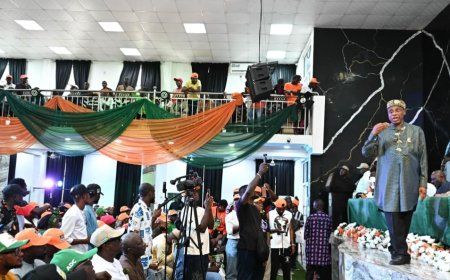
Primary elections in Nigeria have increasingly become ritualistic exercises rather than genuine democratic contests. In 2024, for example, a sitting governor publicly unveiled a list of preferred candidates for local government elections amid loud chants and applause from supporters, as though announcing the results of a primary school graduation exercise. Only weeks ago, a massive crowd gathered in another state to endorse a favoured aspirant. Their principal justification was that he occasionally answered their phone calls and acknowledged their concerns. Apparently, that alone was considered sufficient qualification for higher office; enough, perhaps, to merit the prestigious Mo Ibrahim Prize for Achievement in African Leadership.
Politics ought to be an intellectual enterprise. There exists a natural relationship between intellectual rigour and productive governance. An educated and critically minded citizenry understands the limits of executive authority and recognises when to resist arbitrary power. Sound education cultivates responsible followership, encourages selective obedience where necessary, and promotes civic vigilance against the dangers of servitude.
The consequences of flawed primary elections extend far beyond the fortunes of individual aspirants. When candidates emerge through manipulation, intimidation, or executive imposition rather than merit and popular acceptance, legislative chambers are often populated by individuals whose primary loyalty lies with their political benefactors rather than the electorate. Such legislators are less inclined to exercise independent judgment, scrutinise government policies, or hold the executive accountable. The inevitable result is weakened legislative oversight, diminished checks and balances, and the gradual concentration of power in the hands of the executive. Poor primaries produce poor legislators; poor legislators weaken oversight; and weak oversight, in turn, emboldens executive excesses. The cycle then perpetuates itself, eroding democratic governance and undermining public confidence in political institutions.
Regrettably, available evidence suggests that many of the selections and nominations were facilitated by party officials, delegates, and followers whose commitment to critical inquiry was either weak or entirely absent. This situation was compounded by the participation of political migrants who possessed little ideological affinity with the parties under whose banners they operated. At best, they were strange bedfellows assembled for the sole purpose of legitimising predetermined executive preferences.
Aggrieved aspirants must rise to the occasion and challenge these aberrations. The registries of the Federal High Courts remain open to those who have satisfied the requirements of Section 285(9) of the 1999 Constitution (as amended), mindful of the strict fourteen-day timeline prescribed for the commencement of pre-election actions following party primaries.
They must proceed with courage, audacity, and determination; not merely in pursuit of personal redress, but in the broader interest of deepening Nigeria's electoral jurisprudence, strengthening internal party democracy, and reaffirming the supremacy of the rule of law over executive arbitrariness.
Yet, the future of Nigerian democracy cannot depend solely on courageous courts or aggrieved aspirants. It ultimately rests on citizens, party members, delegates, and political stakeholders who are willing to reject executive dictates, resist the culture of blind followership, and reclaim the democratic space. Democracy thrives not when political power is concentrated in the hands of a few kingmakers, but when ordinary party members insist on transparency, accountability, and respect for due process.
Until followers discover the courage to question authority, reject imposed choices, and defend the integrity of democratic institutions, executive endorsements will continue to masquerade as democratic mandates. The tragedy of Nigerian politics, therefore, is not merely the excesses of those who wield power, but the acquiescence of those who surrender their agency to it. The task before the nation is not only to reform its electoral processes but also to cultivate a citizenry that values principle above patronage, participation above passivity, and democratic choice above executive convenience.
Ori Owan, Esq., writes from Abuja, Nigeria.
Email: ntuokwaori123@gmail.com