


















CROSS RIVER 2027: THE GATHERING STORM IN THE SENATORIAL DISTRICTS

Anthony EKPO BASSEY
Cross River politics has entered that familiar season when old allies begin to study each other with suspicion, when political offices suddenly become crowded with visitors, and when every handshake carries hidden calculations. The journey to 2027 though may appear long on the calendar, but in the villages of Yala, the streets of Ikom and the waterfronts of Bakassi, the battle for the Senate has begun. As always, the contest is not limited to merely between parties, it is a struggle between ambition and survival, between old political structures and emerging voices, as well as between popularity and power.
Ekpenyong, Edet, Inyang, Duke test strength in southern senatorial district
In the Southern Senatorial District, Senator Asuquo Ekpenyong, of the All Progressive Congress, (APC) seems to remain the dominant political figure for now. Young, polished and politically connected, Ekpenyong has carefully projected himself as part of a new generation of Cross River politicians. Among professionals and sections of the urban elites in Calabar, he enjoys a reputation for intelligence, composure and administrative understanding. His supporters argue that he possesses the federal connections and modern outlook needed to attract opportunities to the district, and they added that, he has exercised this gesture, over the past few years.
Be that as it may, political pundits believe that politics in Cross River South is not won entirely in elite circles. In many rural communities, voters still measure politicians through personal accessibility, visible empowerment and emotional connection. Some critics believe that Ekpenyong appears too distant from the grassroots and too protected by establishment politics. Yet even his opponents acknowledge that he benefits enormously from incumbency and the growing strength of the APC in the state.
Here comes Prof. Joseph Edet, of the African Democratic Congress (ADC). He remains one of the most recognisable political names in the South. His strength lies in accessibility and very intimidating academic credentials. He promises to be a voice of reason, if elected to represent his people at the red chambers. Also, the sustained argument that the Akamkpa/Biase area, which is a resourceful part of the senatorial district is yet to produce a senator, may win him empathy which may translate into desirable votes.
However, critics say his political platform, the ADC, is strange to the people and will take a long time to sell its manifesto and ideological direction to the people. In other words, the ADC still struggles with structure, funding and grassroots penetration. Nevertheless, his entry into the contest could alter the political calculations within the district.
The Peoples Democratic Party (PDP) in the South is parading a great mobiliser and grassroots politician, Hon. Florence Inyang. She is a former councilor and a foremost women leader with deep grassroots appeal. Nonetheless, the question critics keep asking is: Does she possess the structure capable of confronting APC dominance? Again, does she also possesses the financial capacity needed to wrestle other heavyweights in the contest ring? Be it as it may, there are also growing conversations around the influence of Arthur Jarvis, the governorship flag bearer of the party who may eventually energise the PDP structure in the district.
There is also Richard Duke of the Nigeria Democratic Congress, (NDC) an emerging figure in the race for the Southern Senatorial District seat at nation’s Red Chambers. Richard Duke believes that he is a stronger voice for the people of the Southern Senatorial District and he is deploying available digital media to prove it. Critics argue that he is a stranger to robust elective contest and his party lacks grassroots structure and support.
*Uncertainty at central as Eteng, Oden, Bassey battle for the Red Chamber seat*
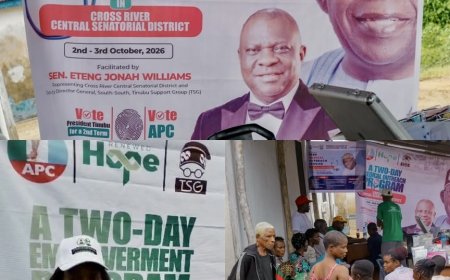
In the Central Senatorial District, the battle promises to be intense and deeply personal. Senator Eteng Jonah Williams, of the All Progressive Congress, APC, remains a major political force despite internal party challenges. A former Speaker of the State House of Assembly, Williams understands the brutal mechanics of grassroots politics. He possesses ward structures, loyal political foot soldiers and years of relationship-building across the district. His supporters believe his experience gives him a strategic advantage over less tested aspirants.
Yet there are signs of voter’s fatigue in some communities. Critics complain that his long years in power have not translated into enough visible transformation across the district. Others accuse him of relying excessively on old patronage networks. Still, nobody familiar with Cross River politics dismisses Eteng Williams casually. Men with deep grassroots structures rarely disappear quietly.
Strongly opposing Sen. Eteng Jones is Oden Ewa of the same All Progressive Congress. Oden Ewa, is increasingly seen by many within the APC as the face of generational transition. His supporters describe him as calm, strategic and intellectually grounded. Many younger voters admire his policy-driven approach and believe that he possesses the temperament required for legislative work.
But Central Cross River politics is rarely decided by intellect alone. Critics insist that Ewa may still lack the emotional grassroots warmth required to dominate local politics. Some argue that he depends too heavily on elite endorsements and may underestimate the complex village-level alliances that determine electoral success.
Mary Ogoba Ekpere Eta, also featured prominently in APC calculations within the district. Courageous and politically ambitious, she represents the gradual emergence of female voices in a terrain still heavily dominated by male political actors. Her supporters see her as focused and determined. But like many female politicians in Nigeria, she confronts the challenge of competing against entrenched political traditions and deeply rooted cultural prejudices. It is uncertain who is the party’s candidate for the central senatorial district until the APC, at the national level, releases the long-awaited results of the primary elections.
Meanwhile, smaller parties such as the Labour Party, SDP, ADC, and NDC are quietly positioning themselves to absorb aggrieved politicians after the major party primaries. But their greatest challenge remains the absence of strong grassroots machinery and financial strength. For instance, we gathered that former Speaker of Cross River State House of Assembly, Rt. Hon Bassey Ewa, is having his eyes on the Senatorial Seat and will be running on the platform of the Nigeria Democratic Congress, NDC. Undoubtedly, Bassey Ewa is a known name in Cross River politics. However, critics argue that he may no longer enjoy the glory of the past era.
*Jarigbe as the dominant figure in the north*
In the Northern Senatorial District, politics remains emotional, intense and deeply rooted in local identity.
Senator Jarigbe Agom Jarigbe, formerly of the Peoples Democratic Party (PDP) but defected to the All Progressive Congress (APC) continues to dominate political discussions in the North. Jarigbe has mastered the politics of visibility and grassroots engagement. Across Ogoja, Yala, Bekwarra, Obudu and Obanliku, many voters see him as approachable and constantly present among the people. His supporters praise his constituency outreach and insist he understands the emotional expectations of Northern Cross River better than many rivals.
His greatest political strengths are familiarity, generosity and the grassroots. He has succeeded in creating the impression that he belongs to the people rather than above them. In Nigerian politics, such emotional connection often matters more than long policy speeches. But criticism follows him as well. Opponents accuse him of depending too heavily on personal popularity.
*Conclusion*
Nonetheless, as matters stand today, the APC appears structurally stronger state-wide because of incumbency and the growing influence of Governor Bassey Otu. The PDP, however, still retains emotional loyalty in the Northern District and parts of the Central District. The ADC and smaller parties may eventually benefit from internal crises within the larger parties, especially after primaries produce inevitable grievances.
But Cross River politics has never been entirely predictable. Between now and 2027, alliances will collapse, friendships will break, and politicians presently ignored may suddenly become central actors in the unfolding drama. In Nigerian politics, no ambition is ever truly dead until the final ballot is counted.
THE BEAGLE NEWS