























“Dedicated to West African Youth”: Why Calabar Must Not Lose the West African Peoples Institute
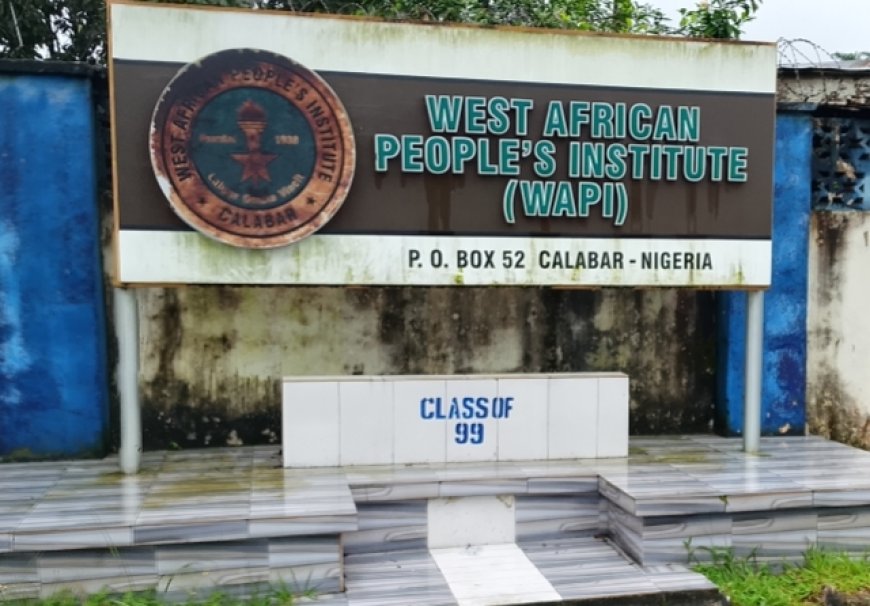
By Joseph Ekpe Edet
I am not an alumnus of the West African Peoples Institute. I attended the prestigious Immaculate Conception Seminary with the youthful idea of becoming a Catholic priest. I drove past the old premises of the West African Peoples Institute in Calabar recently and was compelled to stop. What caught my attention was not merely an old building showing the inevitable effects of age. It was the sight of a piece of our history apparently surrendering, almost unnoticed, to abandonment and physical transformation. I stopped, came down, and took a photograph. On the weather-beaten façade of one of the surviving structures, above broken windows and walls stained by decades of exposure, an inscription remains remarkably visible:
“DEDICATED TO WEST AFRICAN YOUTH.”
Those four words stopped me. They also raise a question that should concern Cross River State and, indeed, Nigeria: How did a place conceived with such an extraordinary vision for African youth come to this? My concern is heightened by what appears to be happening around the historic premises. Some of the old structures that formed part of the West African Peoples Institute complex are disappearing and giving way to modern development, reportedly connected with a hotel project. The precise ownership, approvals, and scope of that development ought to be properly established. But irrespective of who owns the land today, an important question of public heritage arises: Should structures of demonstrable historical significance disappear because the land on which they stand has acquired greater commercial value? I think not.
The West African Peoples Institute—popularly remembered as WAPI—is inseparable from the remarkable life of Professor Eyo Ita, one of the outstanding educationists and nationalists produced by Calabar. Historical records identify Eyo Ita as the proprietor and founder of the West African Peoples Institute. A biographical record preserved by the Biographical Legacy and Research Foundation also records him as a founder of the Nigerian Youth Movement, proprietor of WAPI, Vice-President of the NCNC, and founder of the National Independence Party. WAPI therefore did not emerge simply as another school. It arose from an intellectual and political philosophy about what education should do for an African people living under colonial domination. An especially valuable historical source is a study of Nigerian education between 1842 and 1942. It identifies WAPI as one of the period's outstanding indigenous private educational institutions. It places its establishment within the emergence of Nigerian-controlled schools that challenged both missionary and colonial educational orthodoxies. Significantly, the study notes that Eyo Ita attended Teachers College, Columbia University, where he encountered the educational ideas of John Dewey and William Kilpatrick.
This matters greatly in understanding WAPI.
The school was part of a much larger idea: that Africans should not merely receive an education designed for them by colonial authorities but should participate in defining the purpose, content, and direction of their own education. Education of the head and the hand
WAPI combined academic education with vocational and practical instruction. Historical accounts describe the institution as offering both academic and vocational subjects and associate Ita’s educational philosophy with self-reliance. That explains the building in the photograph.
An architectural account of the WAPI premises describes what appears unmistakably to be this surviving structure: a symmetrical building with a barrel-shaped parapet over staircases leading to the upper level. Most importantly, the author records the inscription “Dedicated to West African Youth” and identifies the structure as having apparently housed WAPI workshops. Suddenly, the decaying building becomes something very different. Those empty openings were once workshop entrances. Those battered walls once enclosed young Africans learning practical skills. And the inscription was not ornamental. It expressed a philosophy.
“Dedicated to West African Youth” meant precisely that: a physical institution committed to preparing young Africans for responsibility, economic independence, and eventually political freedom.
WAPI's importance becomes even clearer when Eyo Ita’s educational activities are placed alongside his nationalism. He belonged to that generation of Africans for whom education and liberation were interconnected. He participated in the youth and nationalist movements of the 1930s and subsequently became an important figure in the NCNC and Nigerian constitutional politics.
The West African Peoples Institute consequently occupied an important intellectual space between education, African self-confidence, vocational development and political emancipation. This makes the surviving structures significant beyond Cross River State. They are physical evidence of a period when Africans were beginning to imagine institutions controlled by Africans and designed around African aspirations. And that is precisely why their destruction would constitute an irretrievable loss.
Calabar is already a city of history. Calabar possesses something that many modern cities spend enormous resources trying to manufacture: authentic history. Its history spans the Efik, Ejagham (Qua), and Efut civilizations; Atlantic commerce; missionary activity; colonial administration; early Western education; and Nigerian nationalism. Hope Waddell Training Institution, established in the nineteenth century, occupies an important place in that history. WAPI represents another stage—the movement from missionary and colonial education towards indigenous African educational initiative. A University of Edinburgh historical study of colonial Calabar specifically distinguishes the church-dominated educational system from institutions established by individuals, identifying the West African Peoples Institute as one such institution founded by Eyo Ita.
WAPI's significance has not faded. As recently as 2017, the United Nations Information Center, working with the Cross River State Government, organized an educational program on slavery and African heritage involving more than 200 students from ten schools. The public awareness rally ended at the WAPI building, where activities included a documentary screening, an exhibition, and a performance by the WAPI school choir. That event demonstrates something important: the WAPI premises already possess the characteristics of a heritage and educational space.
Why, then, should that history be erased? Development does not require demolition of memory. Building a hotel is not inherently wrong. Calabar needs investment. It needs good hotels, tourism infrastructure, jobs, and urban renewal. But development and preservation are not enemies. Some of the world’s most successful tourism cities have learned that their old buildings are economic assets precisely because they are old. Historic structures are restored and incorporated into contemporary developments. Former schools become museums. Railway stations become galleries. Warehouses become cultural centers. Historic districts accommodate restaurants, hotels and businesses while retaining the architecture that gives those places their identity.
Years ago, I visited the famous hotel in Santiago de Compostela, set in an ancient historic building known as the Hostal dos Reis Católicos (the Parador de Santiago de Compostela). It was built in 1501 as a royal hospital to shelter pilgrims completing the Way of St. James. It is often cited as one of the world's oldest running hotel traditions. It is right next to the Santiago de Compostela Cathedral. A 5-star luxury hotel featuring a stunning Plateresque facade, four historic cloisters, elegant antique-furnished rooms, and a fine-dining restaurant. I slept there and was awed by the level of preservation.
A hotel can be built almost anywhere. The West African Peoples Institute can only exist where history placed it. Once an original structure is demolished, no amount of money can reproduce its authenticity. A replica is not heritage. A photograph is not heritage. A commemorative plaque erected after demolition cannot substitute for the building on which Eyo Ita’s generation placed the words: “Dedicated to West African Youth.”
What should be done? Therefore, there should be no rush to demolish any surviving historic WAPI structure. Before further irreversible alteration of the site, the Cross River State Government, relevant federal heritage authorities, historians, architects, town planners, the present owners or occupiers of the property, the WAPI community, and representatives of Professor Eyo Ita’s family should undertake a comprehensive heritage assessment of the entire premises. The first task should be documentation: What structures remain? When was each constructed? What purpose did each serve? Which retain their original architectural fabric? What archival records, photographs, plans, furniture, workshop equipment, school registers, publications and personal papers survive? The historically significant structures should then be conserved and restored.
Most importantly, the surviving workshop building bearing the inscription “Dedicated to West African Youth” should be preserved. Its condition in my photograph makes the urgency obvious. There is an opportunity here that goes considerably beyond merely preventing demolition. The historic core of WAPI could become an Eyo Ita and West African Peoples Institute Heritage Center. One section could tell the story of Professor Eyo Ita: the educator, nationalist, and political thinker who was honored alongside eminent Nigerians at the Centenary celebration by President Goodluck Jonathan. I was present as the Special Adviser to the Governor on Intergovernmental Affairs and Liaison.
Another could reconstruct the history of WAPI and its pioneering combination of academic and vocational education. Another could examine Calabar’s place in the development of education in Nigeria—from missionary institutions such as Hope Waddell to indigenous initiatives such as WAPI. There could be archival exhibitions on Nigerian nationalism, the Nigerian Youth Movement, the NCNC, constitutional development and the emergence of independence. The old workshop itself could once again serve young people—not necessarily as a conventional museum, but as a living center for innovation, crafts, technology, entrepreneurship, and historical education.
What more fitting restoration could there be? A building once dedicated to West African youth could, nearly a century later, be rededicated to another generation of West African youth. We must decide what kind of city Calabar will become. Cities lose their identities gradually. One old building disappears. Then another. A historically significant compound becomes commercially attractive. The original structures appear inconvenient. They are demolished. Modern buildings rise in their place. Years later, people begin asking where their history went.
Calabar must avoid that fate. Modernization should not require historical amnesia. Indeed, Calabar’s history can itself become part of its future economy through heritage tourism, scholarship, museums, cultural festivals and educational tourism. The surviving WAPI structures offer precisely such an opportunity. What I saw when I stopped my vehicle was therefore more than a dilapidated building. I saw a warning. Behind those broken windows lies the story of an African educationist who believed, long before independence, that African youths could be educated not merely to serve an existing system but to build a different future.
The building may be old. The idea written upon it is not. And perhaps that weather-beaten inscription has survived precisely to ask something of our own generation: If Professor Eyo Ita’s generation could build an institution and dedicate it to the future of West African youth, can our generation not preserve it for them? Calabar should not wait until the last historic WAPI wall has fallen before discovering what it has lost. Preserve WAPI. Restore it. Document it. Turn it into a heritage center. Let development take place around it—but let history remain because some buildings occupy land. Others occupy a people's memory.
The West African Peoples Institute belongs to the latter.
Joe Edet, a legal scholar, writes from Calabar